
By Scott Forrester
One of the most powerful ideas I’ve discovered on my leadership journey is the values continuum developed as part of Systems Leadership Theory (SLT), from Ian MacDonald, Catherine Burke and Karl Stewart.
In simple terms, people’s behaviour at work makes sense when you understand how they’re judging what’s going on around them.
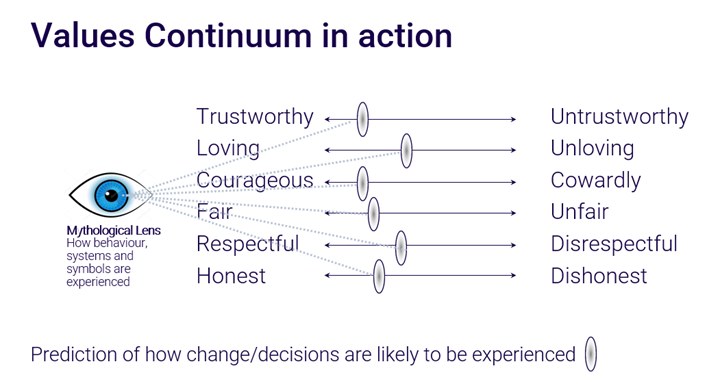
Those judgements are based on some core human values that are consistent across all cultures – love, trust, respect, courage, fairness and honesty. When people feel these values are being lived, they lean in. When they don’t, they pull back, protect themselves, fight or run for the hills.
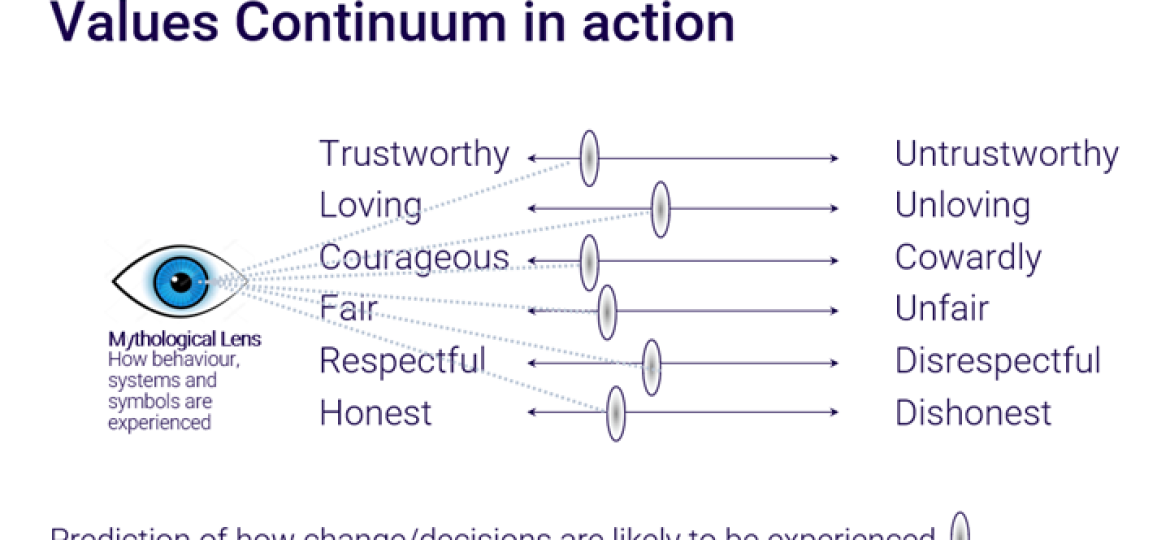
The values continuum is a way of understanding where people are “sitting” in response to those judgements, and also why.
When something happens at work – a new roster, a restructure, a comment in a meeting – people don’t react to the fact alone. They judge it (Was that fair? Honest? Respectful?), make up and often share a story about it (What’s really going on here?), and then behave in certain ways based on their perception or belief. Over time, these shared stories and beliefs strengthen into mythologies – the “truths” people believe about what this place and its leaders are really like. When a group of people share mythologies, a culture is formed.
Think of the continuum like a sliding scale. At one end people don’t feel treated fairly or honestly and they don’t trust what leaders say. Behaviour there is often self‑protective: defensiveness, compliance without commitment, politics and side conversations. In the middle, some things feel fair and respectful, some don’t, so people might focus on belonging and keeping their place – “we look after our own”, “that’s just how we do things here” – which is stable but can be resistant to change.
At the positive end, people mostly experience fairness, honesty, courage, respect and trust. Behaviour there is generally more open and growth‑oriented: asking real questions, trying new things, owning up to mistakes and working for the longer‑term good, not just short‑term self‑protection. Same humans. Different place on the continuum, depending on how they read what’s happening around them based on their mythologies and previous experiences.
If you have a clear understanding of the beliefs, stories, and mythologies in your team – including how both you as a leader and the organisation as a whole are viewed – the values continuum lets you predict people’s probable reactions in advance. Before you announce a change, you can ask yourself: given their past experience and mythologies, will they see this as fair or another stitch‑up? Do they believe what we say, or assume there’s a hidden agenda? Will this feel respectful of their work and dignity, or like it’s being done to them?
If the likely answers are “unfair, not honest, not respectful,” you can safely predict pushback, quiet non‑compliance, or polite agreement followed by work‑arounds. If people generally experience leaders as fair, honest, respectful, courageous, and trustworthy, you can predict challenge in good faith, questions that improve the change, and a decent chance they’ll give it a go.
The real move here isn’t “how do I get them to behave the way I want?”. It’s: given their mythologies and history here, what are they likely to believe about this decision, how are they likely to behave – and what can I do or change in my plan to make it be experienced as positive against our core human values?
Don’t get me wrong, leaders at times will have to make decisions that some will view as negative against these values, but being able to predict how it will be viewed by various people and groups can be very powerful and helpful for leaders.
Over time, consistent acts that are experienced positively against these core human values give people new experiences to judge, new stories to tell, and a slow shift along the values continuum toward the positive end. That’s how this idea turns into a practical leadership habit: you can read the room, predict the reaction, and deliberately shape the conditions for a more productive outcome that aligns with your desired culture and the pursuit of the organisation’s purpose in a positive way.
This article is written by Scott Forrester and is his personal interpretation and articulation of ideas found in Systems Leadership: Creating Positive Organisations (Second Edition) by Ian Macdonald, Catherine Burke and Karl Stewart.
At LKS Quaero, we help leaders to create the culture that gets the desired results. For more information, visit us at lksquaero.com or follow us on LinkedIn and Facebook.