
By Scott Forrester
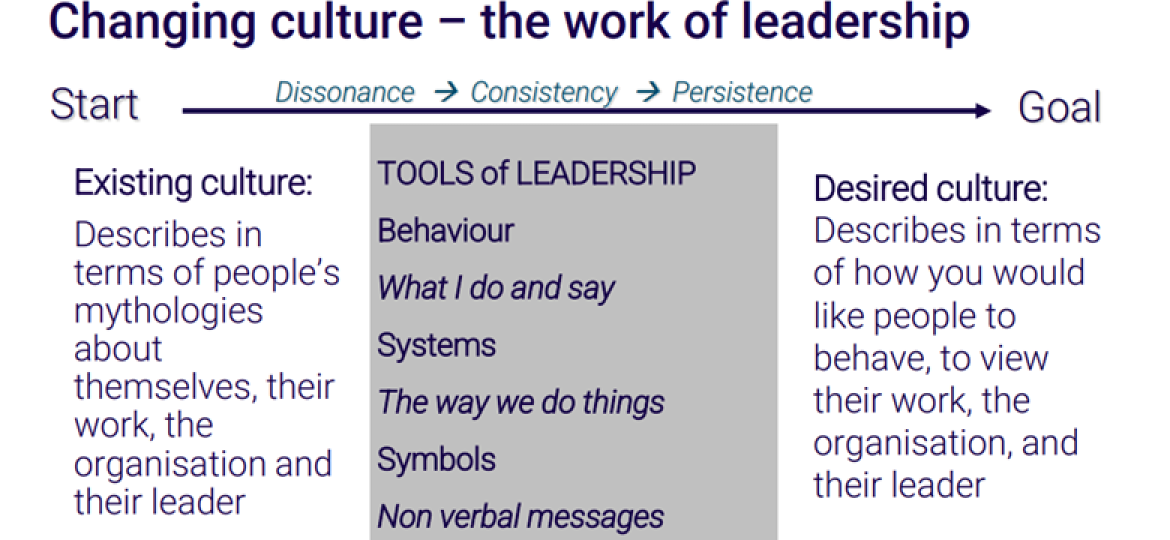
A culture is formed when people share mythologies – shared assumptions about the behaviour of themselves, their work, the organisation and their leaders.
In simple terms, a culture is the set of stories and beliefs people carry about “what really happens around here”.
Those beliefs are built from experience and listening to others stories about the way things are. People watch what leaders do, what they tolerate, what gets rewarded, what gets ignored, and what the organisation’s systems make easy or hard. Over time, those observations become shared assumptions. That is the culture.
So the work of leadership is not just to describe a better culture. It is to create and maintain one.
A leader needs to understand how people currently see themselves, each other, their work, the leader and the organisation. Then the leader needs to predict how people might interpret decisions, actions and changes.
That matters because the same decision can be read very differently depending on the existing culture. In a high-trust culture, a change may be seen as sensible. In a low-trust culture, the same change may be seen as another stitch-up.
The Systems Leadership Theory culture change model gives leaders three practical tools of leadership:
Behaviours — what I do and say
Leaders create culture through their own behaviour. What they pay attention to, challenge, ignore, praise and repeat all becomes evidence for people.
Symbols — the non-verbal messages
Symbols are the things people notice, often before they believe the words.
A closed office door can say, “I’m not available.” An exclusive car park can say, “Some people matter more than others.” A messy workshop or neglected office can say, “Standards and safety don’t really matter here.” A clean, orderly work area can say, “We respect the work, the people doing it, and the customers who rely on us.”
Symbols can be small, but they are powerful because people use them as evidence. None of these things are neutral. People read them. Then they form beliefs about what the organisation really values.
Systems — the way we do things
Systems are the frameworks, processes and procedures that order the flow of work, information, money, people and equipment. They set limits around people’s behaviour. If a system rewards the wrong behaviour, is experienced as counter-productive or not carried out in an authorised way it can have a huge impact on the organisation.
The leader’s job is to use these three tools to create the desired culture. Making changes using the tools will create dissonance at first, because the new behaviour may not match people’s old assumptions. People may test it. They may doubt it. They may wait to see if it lasts.
That is why culture change needs consistency and persistence.
One speech will not change culture. One workshop will not change culture. But repeated behaviour, clear symbols and aligned systems can.
Over time, people get new experiences. New experiences create new judgements. New judgements create new mythologies. And new shared mythologies become the new culture. That is the practical work of Systems Leadership: not slogans, not posters, not wishful thinking, but deliberately shaping what people experience every day.
This article is written by Scott Forrester and is his personal interpretation and articulation of ideas found in Systems Leadership: Creating Positive Organisations (Second Edition) by Ian Macdonald, Catherine Burke and Karl Stewart.
At LKS Quaero, we help leaders to create the culture that gets the desired results. For more information, visit us at lksquaero.com or follow us on LinkedIn and Facebook.